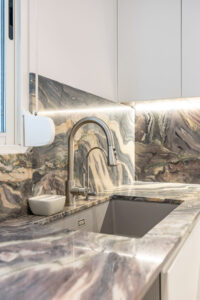
Before and after: the transformative capacity of a well-designed refurbishment
Before and after: the transformative capacity of a well-designed refurbishment
In the world of interior design and refurbishments, change is constant. Not only due to the emergence of new materials and techniques, but above all because of the growing demand for comfort, functionality, and spaces that truly adapt to the lifestyle of their inhabitants.
A well-planned refurbishment can go far beyond a simple aesthetic improvement: it has the potential to completely transform a home. The classic “before and after” is the best way to demonstrate this: it shows how a detailed analysis, intelligent distribution, and solid design can radically change the way a space is experienced.
1. Visualising potential: clarity from the outset
Many refurbishments begin with doubts or uncertainty: the existing space feels uncomfortable, impractical, or simply outdated. Conducting a thorough preliminary analysis and visualising the potential of the dwelling allows for a recovery of the overall vision of the project and helps to identify opportunities that may go unnoticed at first glance.
Why it is essential:
- It reveals possibilities that the client had not considered.
- It identifies which elements should be retained, modified, or removed.
- It generates confidence that the investment will truly improve the quality of life in the home.
A solid design translates these findings into a logical, realistic, and achievable plan, the foundation of any successful transformation.
2. From old distribution to intelligent solutions
One of the great achievements of a well-designed refurbishment is optimising the distribution. What was once perceived as a narrow, dark, or impractical space can be transformed into spacious, bright, and coherent areas.
Impact of an intelligent distribution:
- It corrects inefficient circulation.
- It maximises the entry of natural light.
- It makes functional use of every square metre.
The final result is not only aesthetically pleasing: the dwelling becomes more practical, comfortable, and efficient for everyday life.
3. Materials, colours, and finishes that define the atmosphere
Beyond distribution, the choice of materials, colours, and finishes is crucial in the transformation. The combination of warm woods, neutral tones, high-quality finishes, and strategic lighting ensures that a space not only looks different but also feels different.
Keys to successful selection:
- Combine timeless materials with trendy details.
- Prioritise durability and ease of maintenance.
- Use contrasts and textures to add depth and character.
This results in an interior that is personal, welcoming, and sustainable.
4. Clear communication with the client
During a refurbishment, numerous decisions are made, many of which are laden with emotion. Maintaining a fluid communication structure between designer, contractor, and client prevents misunderstandings and ensures an efficient process.
Benefits of good communication:
- The client understands each stage of the project.
- Errors are detected and corrected in a timely manner.
- The entire team works towards a common goal.
This reinforces trust and keeps the project within the planned timeline and budget.
5. The moment of transformation: the “before and after”
When the design materialises, the client truly experiences the power of a well-executed refurbishment. The comparison between the “before and after” is often surprising: dark corners disappear, spaces seem larger, the atmosphere changes completely, and the home adapts to the lifestyle of its inhabitants.
Examples where this impact is most evident:
- Kitchens that become the functional heart of the home.
- Bathrooms focused on comfort and relaxation.
- Living rooms that gain light, spaciousness, and connection with the rest of the dwelling.
The “after” is proof that a careful design and precise execution radically transform the experience of inhabiting a space.
Conclusion
A well-designed refurbishment not only modifies the appearance of a space but also changes the way it is lived in. The “before and after” reflects the power of a project that combines aesthetics, functionality, and personality.
By paying attention to analysis, distribution, material selection, and communication, a clear and secure process is generated, where the refurbishment ceases to be just a construction project and becomes a true transformation that enriches the lives of those who inhabit the space.
Full refurbishments must comply with the urban planning regulations of the Ayuntamiento de Valencia.
You may also be interested in: errors in full refurbishments and turnkey architecture.